Select Language

Selecting the right mobility system for specialized robotics often comes down to the trade-off between stability, payload capacity, and terrain adaptability. While wheels offer speed on flat surfaces, tracked systems are indispensable for unmanned vehicles operating in unpredictable environments, from agricultural fields to disaster zones.
The technical challenge for engineers is no longer just about movement, but about minimizing energy loss while maximizing structural resilience. This shift has placed a spotlight on the materials used in the chassis and the precision of the components provided by robot track suppliers, where the integration of lightweight alloys and high-strength composites determines the operational window of the robot.
Understanding the intersection of material science and mechanical design is critical for optimizing robotic performance. This article examines the core selection criteria for robotic tracks and the structural innovations currently driving efficiency in UAV and UGVs.


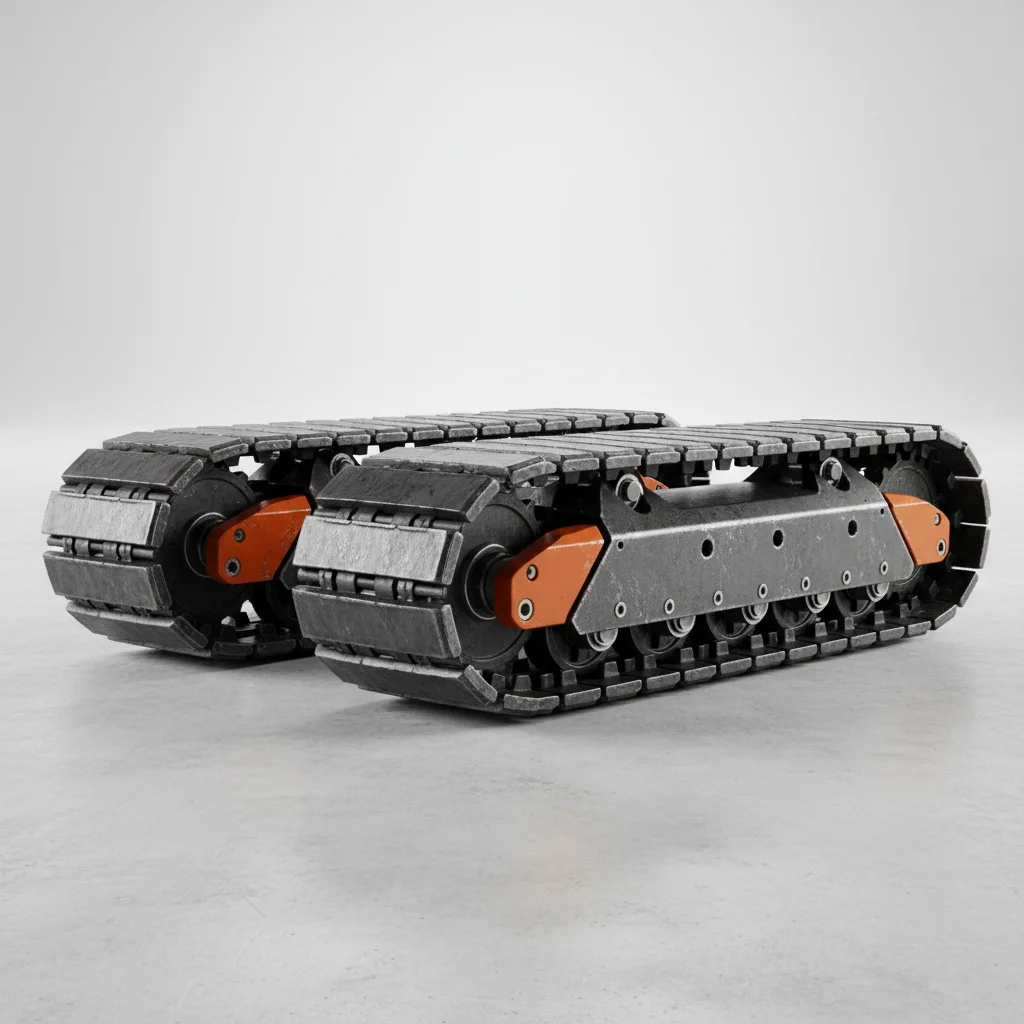
Tracked movement differs from wheeled locomotion primarily through the distribution of ground pressure. By increasing the surface area in contact with the terrain, tracked robots can traverse soft soil, sand, or snow without sinking—a requirement that makes specialized robot track suppliers essential for agricultural and rescue robotics.
The mechanical efficiency of these systems depends on the friction coefficient between the track material and the environment, as well as the rigidity of the supporting frame. If the frame flexes too much under load, the track may derail, leading to catastrophic failure in the field.
For mobile robots, every gram of unplanned weight reduces battery life and increases the inertia the motors must overcome. This is why the transition from heavy steel frames to aerospace-grade aluminum and carbon fiber has been pivotal. The use of Aluminum Alloy 6061, for instance, provides a critical balance, offering a yield strength between 110 and 180 MPa while remaining significantly lighter than traditional ferrous metals.
Precision machining, such as CNC cutting and high-temperature curing, allows for the creation of components with uniform thickness and optimal aerodynamic or hydrodynamic profiles. This precision ensures that the load is distributed evenly across the chassis, preventing localized stress concentrations that could lead to fatigue cracks over thousands of operational cycles.
Furthermore, the integration of reinforced composite materials—such as carbon-fiber-reinforced polymers—allows for higher torsion strength. This is particularly important for robots that must navigate steep inclines or carry heavy sensors, where the structural integrity of the arm or track support must withstand significant bending moments without permanent deformation.
Modern robotic design is moving toward modularity to increase deployment speed. In emergency rescue or firefighting scenarios, the ability to quickly swap out damaged components or adjust the robot's geometry is a strategic advantage. This is evident in the development of quick-release folding mechanisms and direct-connect structural tubes.
Structural stability in unmanned vehicles is not merely about material hardness, but about the synergy between high-strength alloy frames and the efficiency of the folding or locking mechanisms to maintain a consistent center of gravity during movement.
These modular components, often utilizing CNC-machined aluminum joints, allow a robot to transform from a compact transport state to a flight-ready or drive-ready state in seconds. Such efficiency reduces the logistical burden on operators and ensures that the hardware can be deployed in time-sensitive environments without complex assembly.
Evaluating the performance of a track system involves analyzing several key indices: impact resistance, folding efficiency, and load-bearing capacity. For instance, adopting an aerospace-grade aluminum frame can enhance impact resistance by up to 200% compared to legacy models, ensuring that the robot can survive sudden collisions during rough-terrain navigation.
The relationship between material choice and operational efficiency can be visualized through a relative performance index. While carbon fiber offers the highest rigidity-to-weight ratio, aluminum alloys provide a more cost-effective solution for components requiring high impact durability and ease of customization.
The environmental stressors on robotic tracks vary wildly by application. In agricultural drones or ground vehicles, exposure to fertilizers and moisture requires materials that are naturally corrosion-resistant and waterproof. Similarly, emergency rescue robots often operate in high-temperature or humid environments, where UV resistance and thermal stability of the polymer or alloy components are paramount.
Material distribution drones, for example, require high torsion strength to prevent frame warping under uneven loads. By utilizing customized tube diameters—ranging from 25mm to 80mm—manufacturers can tailor the structural stiffness to the specific payload requirements of the mission, ensuring that the drone maintains a stable center of gravity during flight or transit.
The industry is shifting away from monolithic material designs toward hybrid structures. Combining the impact resistance of aluminum alloy connectors with the extreme rigidity of full-carbon fiber tubes creates a system that is both durable and ultra-lightweight. This hybrid approach allows for the optimization of internal wiring channels and signal cable routing without compromising structural strength.
Future developments are likely to focus on "smart" materials—composites that can sense stress or fatigue in real-time. This would allow robotic systems to alert operators before a structural failure occurs, which is critical for high-value industrial inspection robots operating in hazardous areas.
As UAVs and UGVs become more specialized, the demand for OEM and ODM customization grows. The ability to specify carbon fiber layup angles and custom mounting hole patterns enables developers to build frames that are mathematically optimized for their specific motor torque and weight distributions.
When selecting a supplier for robotic tracks or structural components, engineers must look beyond the primary material. The manufacturing process—whether it involves filament winding, CNC cutting, or high-temperature curing—directly impacts the uniform thickness and aerodynamic performance of the final product.
A critical trade-off exists between deployment speed and lock security. Quick-release models enhance operational efficiency but require rigorous fatigue testing to ensure the locking mechanism does not fail after repeated cycles. Direct-connect models offer higher reliability in extreme vibration environments but lack the portability required for rapid field deployment.
The following evaluation framework provides a comparison of common material and design choices based on operational requirements.
| Material/Design | Torsion Strength | Impact Resistance | Weight Profile | Typical Use Case |
|---|---|---|---|---|
| Carbon Fiber Composite | Very High | Moderate | Ultra-Light | Long-range UAVs |
| Alloy 6061 (Standard) | Moderate | High | Light | Agricultural Robots |
| Alloy 6061-T6 | High | Very High | Light | Emergency Rescue |
| Glass Fiber Hybrid | Moderate | Moderate | Moderate | Industrial Cleaning |
| Quick-Release Joint | Moderate | Moderate | Variable | Rapid Deployment |
| Direct-Connect Tube | High | High | Fixed | Heavy Payload UGVs |
Tracked systems significantly reduce ground pressure by distributing the robot's weight over a larger surface area. This prevents the vehicle from sinking into soft or unstable terrains such as mud, sand, or snow, providing superior flotation and traction compared to wheels, which concentrate weight on small contact points.
The specific alloy and its tempering (e.g., 6061-T6) determine the yield and tensile strength. Using aerospace-grade alloys ensures the frame can withstand higher flight or operational pressures without permanent bending. Higher-grade alloys also improve impact resistance, which is vital for robots operating in unpredictable industrial or rescue environments.
Quick-release mechanisms are ideal for scenarios requiring rapid deployment and high portability, such as emergency rescue or firefighting. Direct-connect models should be chosen for heavy-duty applications where maximum structural rigidity and vibration resistance are required, and where the robot does not need to be folded for transport frequently.
While carbon fiber offers an exceptional strength-to-weight ratio, it can be more brittle than aluminum under sharp, high-energy impacts. For robots prone to collisions or those operating in highly abrasive environments, a hybrid approach—using aluminum for high-impact joints and carbon fiber for structural tubes—is often the most reliable solution.
Professional suppliers typically offer customization of tube diameters (e.g., 25mm to 80mm), carbon fiber layup angles for specific stiffness, surface finishes (matte, glossy, or anti-slip), and custom mounting hole patterns to integrate with specific motors, ESCs, or sensor gimbals.
Environmental factors like salt spray in coastal areas or extreme heat in deserts necessitate materials with high corrosion and UV resistance. Composite materials and anodized aluminum alloys are preferred as they do not rust and maintain their structural integrity across a wide range of temperatures and humidity levels.
The efficiency of a robot's mobility system is a direct reflection of its material engineering. By moving toward lightweight, high-strength composites and precision-machined alloys, manufacturers can significantly expand the operational capabilities of unmanned vehicles in the field.
Whether optimizing for rapid deployment in rescue missions or maximum stability in agricultural applications, the focus remains on the balance between structural rigidity and total system weight. As the industry evolves, the integration of modularity and hybrid materials will continue to define the next generation of robotic mobility.