In the rapidly evolving landscape of energy storage, the stability and longevity of battery systems depend heavily on the materials used for isolation and support. An EPDM battery pad serves as a critical interface, providing the necessary vibration dampening and environmental sealing required to protect sensitive cells from external stressors. By utilizing Ethylene Propylene Diene Monomer (EPDM), manufacturers can ensure that battery arrays remain secure and functional even in the most demanding industrial environments.
Globally, the shift toward electric mobility and renewable energy grids has placed an unprecedented demand on high-performance rubber components. The integration of a specialized EPDM battery pad is no longer just an optional accessory but a fundamental requirement for meeting ISO safety standards and enhancing the operational lifespan of power systems. These pads mitigate the risks of mechanical wear and chemical degradation, which are common failure points in large-scale battery deployments.
Understanding the technical nuances of these components allows engineers to optimize thermal management and structural integrity. Whether applied in automotive chassis or stationary energy storage systems, the EPDM battery pad offers a unique combination of ozone resistance, weatherability, and compression set resistance. This comprehensive guide explores how these specialized rubber pads contribute to global energy efficiency and system reliability.

The Global Industrial Context of EPDM Battery Pads
The global transition toward electrification, supported by initiatives from the International Energy Agency (IEA) and various ISO standards, has highlighted a critical vulnerability in battery architecture: mechanical vibration. As battery packs become heavier and more densely packed, the risk of internal cell damage due to road vibration or industrial oscillation increases. This is where the EPDM battery pad becomes essential, acting as a shock absorber that prevents premature fatigue of electrical connections.
In regions like Europe and North America, where extreme temperature fluctuations are common, the chemical stability of the padding material is paramount. EPDM's unique molecular structure allows it to remain flexible at sub-zero temperatures and stable under high heat, solving the challenge of material embrittlement that plagued earlier generations of rubber insulators. This reliability is crucial for maintaining the safety integrity of high-voltage systems in diverse climates.
Defining the Technical Role of EPDM Battery Pads
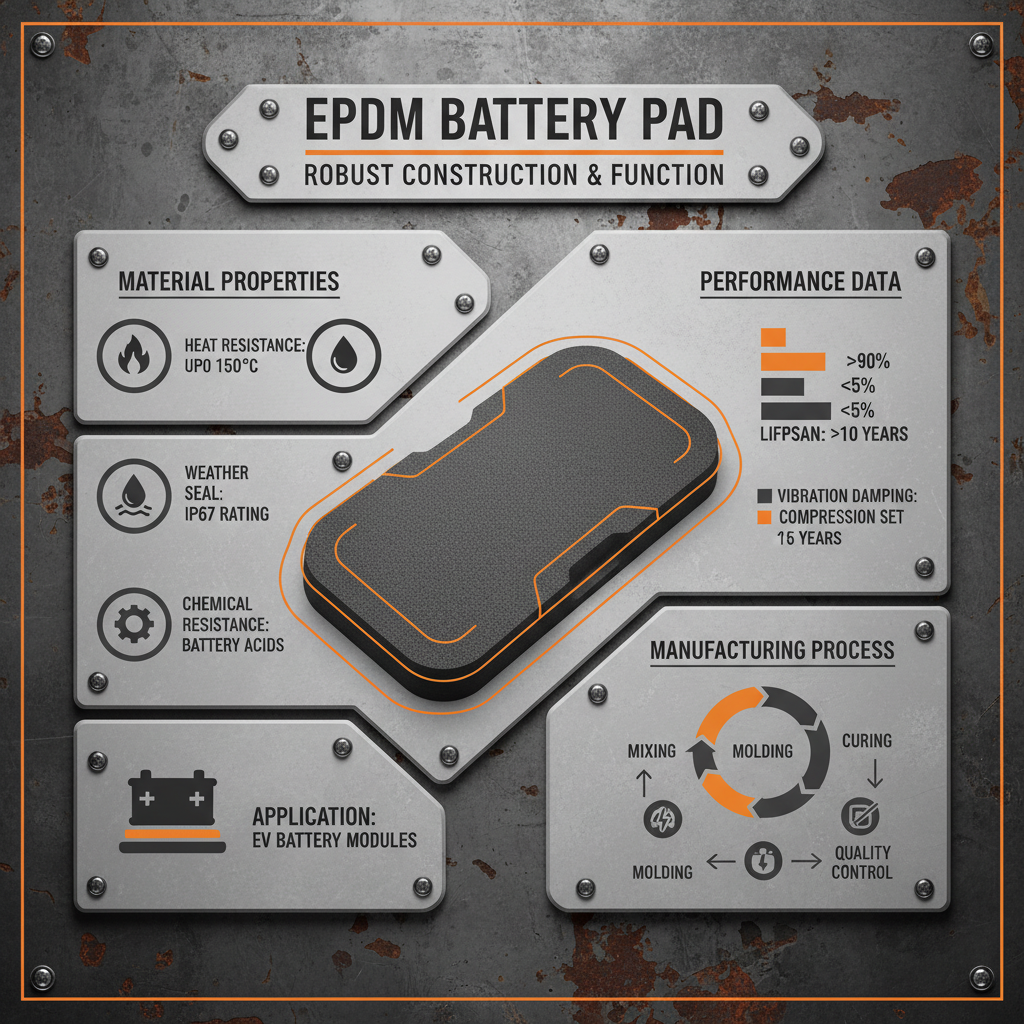
At its core, an EPDM battery pad is a precision-engineered elastomer component designed to provide a physical barrier between the battery cell and its housing. Unlike standard rubber, EPDM (Ethylene Propylene Diene Monomer) is specifically synthesized to resist heat, oxidation, and weather, making it the ideal candidate for the harsh environments found in automotive engine bays or outdoor energy storage containers.
Beyond simple cushioning, these pads serve as dielectric isolators, preventing electrical leakage or short circuits that could lead to thermal runaway. By providing a consistent compression force, the pad ensures that the battery remains seated securely, eliminating the "chatter" or micro-movements that can wear down terminal connectors over thousands of miles of operation.
From a humanitarian and safety perspective, the implementation of high-quality padding reduces the likelihood of battery fires and leaks. In modern industry, where "zero-failure" is the goal for critical infrastructure, the EPDM battery pad represents a low-cost but high-impact solution to a complex engineering problem.
Core Components and Material Properties
The efficacy of an EPDM battery pad is rooted in its exceptional resistance to environmental degradation. One of the most critical factors is its "Compression Set" resistance, which refers to the material's ability to return to its original thickness after prolonged loading. This ensures that the vibration dampening properties do not vanish after a few months of use.
Furthermore, the chemical composition of the EPDM battery pad is engineered to be inert. This means it will not react with battery electrolytes or common industrial lubricants, preventing the material from swelling or dissolving, which would otherwise compromise the structural support of the battery array.
Finally, scalability in manufacturing allows these pads to be customized in terms of hardness (Shore A) and thickness. Whether a system requires a soft, high-damping pad for delicate electronics or a firm, load-bearing pad for heavy-duty industrial batteries, the versatility of EPDM enables precise tuning to match specific application requirements.
Performance Metrics and Efficiency Factors
Evaluating the performance of an EPDM battery pad involves analyzing its energy absorption capacity and its thermal conductivity. High-efficiency pads are designed to dissipate mechanical energy as heat, preventing that energy from reaching the battery cells, thereby extending the total cycle life of the battery.
When comparing different formulations, the balance between durability and flexibility is key. A pad that is too hard may transmit too much vibration, while one that is too soft may collapse under the weight of the battery. The following data illustrates the relative performance ratings of various EPDM formulations based on industry testing.
EPDM Battery Pad Formulation Comparison
Global Applications and Real-World Use Cases
The versatility of the EPDM battery pad allows it to be deployed across a staggering array of industries. In the automotive sector, specifically for Electric Vehicles (EVs), these pads are integrated into the battery tray to protect cells from road-induced shocks. In rail transit, they are used to isolate massive battery banks from the constant vibration of the tracks, ensuring uninterrupted power for signaling and onboard systems.
Beyond transportation, we see critical use cases in UAV (drone) technology and underwater cleaning robots, where weight-to-performance ratios are tight. In these niche applications, custom-molded EPDM pads provide the necessary stability for battery packs subjected to high G-forces or hydrostatic pressure. Similarly, in remote industrial zones, such as wind farms or solar arrays, these pads protect stationary energy storage systems from seismic activity and thermal expansion.
Long-Term Value and Sustainability Benefits
Investing in a premium EPDM battery pad yields significant long-term economic value by reducing the frequency of battery replacements. When cells are protected from mechanical stress, their internal chemistry remains stable for longer, which directly translates to a lower total cost of ownership (TCO) for the end-user and a reduced waste stream for the planet.
From a sustainability angle, EPDM is highly durable, meaning the pads themselves do not need frequent replacing. This longevity reduces the volume of industrial rubber waste. Moreover, by preventing battery failures and subsequent hazardous leaks, these pads act as a primary line of defense for environmental protection, particularly in sensitive ecosystems where battery-powered equipment is deployed.
Emotionally, the use of such components builds trust between the manufacturer and the consumer. Knowing that a system is engineered with high-grade isolation materials provides a sense of safety and reliability, which is indispensable for high-stakes applications like medical equipment or emergency backup power systems.
Future Trends in Battery Isolation Technology
The future of the EPDM battery pad lies in the integration of "smart" materials. We are seeing a trend toward the development of conductive EPDM blends that can simultaneously provide vibration dampening and thermal conductivity, allowing the pad to help pull heat away from the battery cells and move it toward the cooling system.
Additionally, the rise of automation in manufacturing is enabling "generative design" for rubber components. Instead of simple flat pads, we will see complex, 3D-lattice EPDM structures that are optimized via AI to provide maximum dampening with minimum material use. This shift toward lightweighting is essential for the next generation of UAVs and high-performance electric cars.
Finally, there is a growing push toward bio-based EPDM alternatives to further reduce the carbon footprint of production. As green chemistry advances, the industry is moving toward materials that maintain the same rigorous standards of the EPDM battery pad while being derived from sustainable feedstocks.
Technical Analysis of EPDM Battery Pad Specifications
| Material Grade |
Hardness (Shore A) |
Temp Range (°C) |
Vibration Absorption |
| Industrial Standard |
60 ± 5 |
-40 to +120 |
Medium (7/10) |
| High-Damping Grade |
40 ± 5 |
-50 to +100 |
High (9/10) |
| Heavy-Duty Load |
80 ± 5 |
-30 to +150 |
Low (5/10) |
| Weather-Resistant |
50 ± 5 |
-60 to +110 |
Medium (8/10) |
| Thermal-Conductive |
65 ± 5 |
-40 to +130 |
Medium (7/10) |
| Ultra-Flexible |
30 ± 5 |
-70 to +90 |
Very High (10/10) |
FAQS
EPDM offers a superior balance of weather resistance and cost-effectiveness. While silicone can handle higher temperatures, EPDM has better mechanical strength and ozone resistance, making it more durable for automotive and outdoor industrial applications. Neoprene, while strong, lacks the extreme temperature flexibility and UV resistance that EPDM provides for long-term battery isolation.
Depending on the environment, inspections should occur every 24-36 months. In high-vibration settings like heavy machinery, check for signs of "compression set" or cracking. Because EPDM is highly durable, replacement is rarely needed unless the pad has been exposed to incompatible solvents or severe mechanical puncture.
While the pad itself is not a cooling system, it prevents the mechanical triggers of thermal runaway. By stopping cell-to-cell friction and preventing punctures from housing vibrations, the EPDM battery pad reduces the risk of internal shorts that lead to overheating. Some advanced grades also assist in thermal dissipation.
Yes, EPDM is generally chemically inert and compatible with Lithium-ion, LiFePO4, and Lead-Acid batteries. Its resistance to electrolytes and acids ensures that it will not degrade when in contact with the exterior casing of various battery types, making it a universal solution for energy storage.
For heavy industrial batteries, a higher Shore A (70-80) is recommended to prevent the pad from bottoming out. For precision electronics or lightweight UAV batteries, a lower Shore A (30-50) is better for maximizing vibration absorption. Always match the hardness to the static load of the battery.
Absolutely. In the automotive industry, Noise, Vibration, and Harshness (NVH) are critical. An EPDM battery pad decouples the battery mass from the vehicle chassis, significantly reducing the humming or rattling noises that can be transmitted into the passenger cabin during operation.
Conclusion
The EPDM battery pad stands as a silent but indispensable guardian of modern energy systems. From its exceptional resistance to environmental stressors to its critical role in vibration dampening and electrical isolation, it ensures that the batteries powering our future remain safe and efficient. By bridging the gap between raw power and structural stability, these components reduce operational risks and extend the lifecycle of critical infrastructure.
As we look toward a future of smarter, greener energy, the evolution of isolation materials will be key to unlocking higher energy densities and safer transport. We recommend that engineers prioritize high-grade EPDM formulations to future-proof their designs against the challenges of climate change and urban vibration. For those seeking industry-leading isolation solutions, we invite you to explore our professional range. Visit our website: www.sunlitetek.com

 Select Language